If you would like to know more…
The museum’s courtyard belonged to the former Colegio de la Merced y Santísima Trinidad. A plaque bearing the institution’s name can still be seen on one of the pillars of the cloister, preserved as a reminder and tribute to all those who passed through its classrooms.
The girls’ school began operating in 1903 and remained active until 1998. Its foundation formed part of the broader effort by women’s religious orders in the late 19th and early 20th centuries to provide shelter and education for the sons and daughters of women from working-class neighbourhoods such as El Molinillo.
The museum was established in 2014, making use of the disused areas of the Mercedarian Sisters’ enclosed monastery, which remains active today. The original building was designed in 1878 by Manuel Rivera Valentín, then diocesan architect, thanks to the financial support of its founder, Mercedes Bisso Vidal. Since its construction in 1893, it has been one of the most emblematic buildings in the Barrio de la Cruz del Molinillo, alongside the former Molinillo First-Aid Centre and the Salamanca Market, both of which were built later.
Rivera Valentín’s building belongs to the Neo-Medieval movement that became popular in Europe and the United States during the 19th century. His religious buildings combine features of Romanesque and Gothic architecture in a synthesised form, as can be seen in the façade of this monastery, in the nearby convent of the Carmelite Sisters of Saint Joseph on Calle Don Rodrigo, designed in the same year, and in several family mausoleums he designed for prominent families at the San Miguel Cemetery.
The El Molinillo neighbourhood takes its name from the olive oil mill that once stood on a plot of land now adjacent to the monastery. The area forms part of the former Fontanella suburb, one of the two medieval districts located outside the city walls. Its inhabitants were mainly engaged in pottery, which gave its name to Calle Ollerías, along which the museum’s side façade runs. The area’s natural clay deposits, particularly those of the nearby Ejido, were used to produce kitchenware and everyday utensils in traditional clay ovens.
At the time the building was constructed, historical sources describe the neighbourhood as retaining a distinctly rural character, with numerous estates, orchards and bakeries. Today, traces of the former orchards can still be seen in some unused plots, while only one remains intact, within the grounds of the Mercedarian convent.
At one end of the courtyard stands the now-famous mandarin tree, planted by the convent’s founder. More than 150 years old, it continues to bear fruit every winter and provides welcome shade for visitors who sit beneath it to contemplate the beauty of the surroundings.
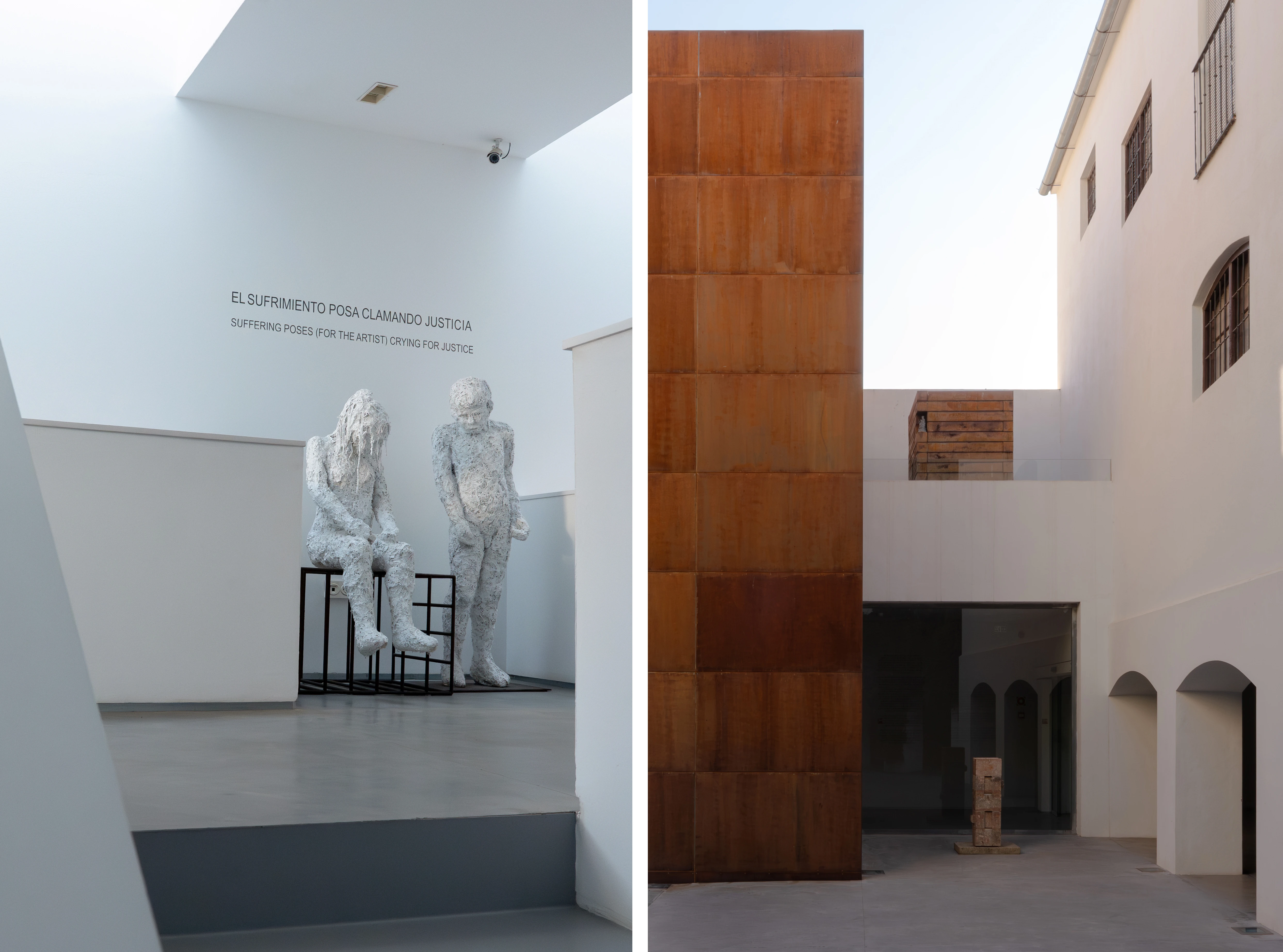
The construction of the museum combines traditional and contemporary materials, giving the building its distinctive aesthetic: polished concrete and Corten steel, with its characteristic weathered appearance. The spirituality and serenity of the monastic setting are reflected in the historic brickwork and white walls, while the strength and austerity of the Expressionist style find their counterpart in the steel and concrete. Together, these elements create a compelling visual dialogue that also reflects the essence of Rando’s work: the dialogue between harshness and compassion, suffering and spirituality.